Controlled-release intra-oral delivery
MEDORA™
A platform for formulation and device co-development. Therapeutic, cessation and wellness concepts built around a removable oral interface.
Development opportunity
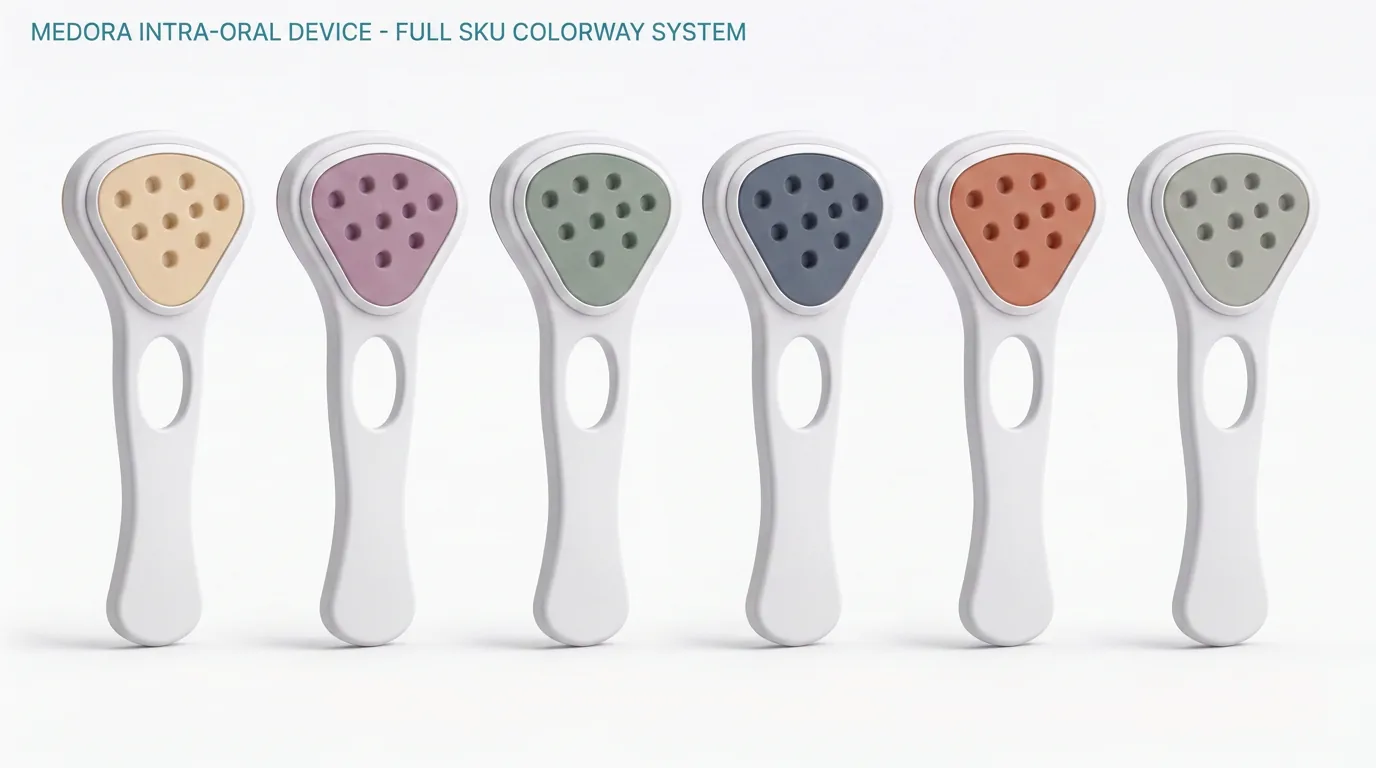
Platform development
The delivery opportunity
A removable oral device for selected ingredients and intended uses.
A different administration interface
A removable oral device for selected ingredients and intended uses.
The intended benefit
Engineer contact area and release behavior around a defined product requirement.
The development question
Can a specific formulation deliver a reproducible amount within the intended contact time, with acceptable safety and usability?
How the concept works
Load and wet
Incorporate selected ingredients into a matrix or release layer. Saliva contacts the release surface.
Release and contact
Ingredients leave the formulation and contact the oral environment. Local or systemic delivery is product-specific.
Remove
Removal ends device contact. It does not reverse prior absorption or establish an immediate end to drug effects.
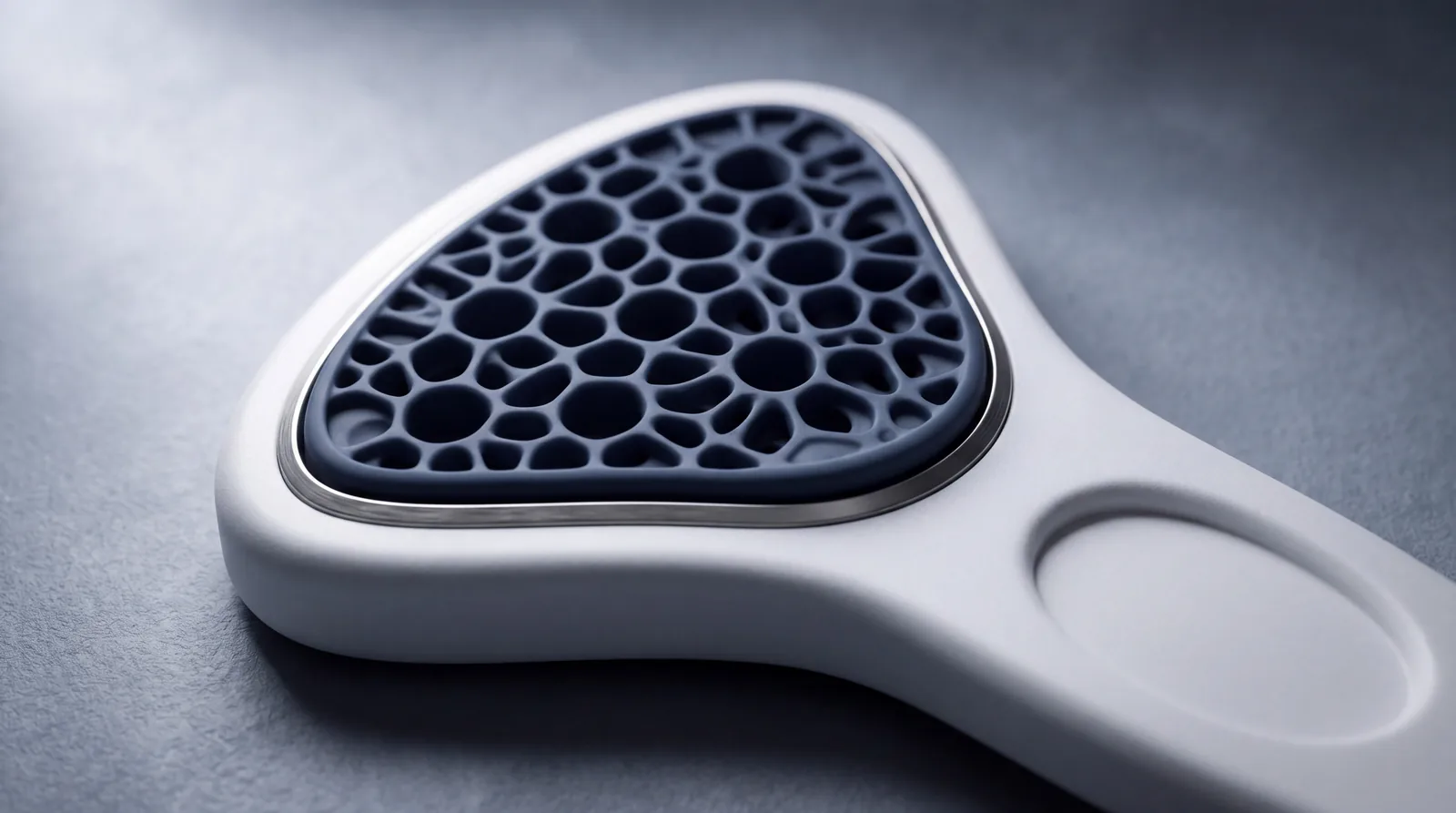
A silicone delivery architecture
Formulation
Ingredient loading, solubility and compatibility influence the available formulation space.
Material and geometry
Matrix properties, release layers and contact surface define design variables.
Measured performance
Release behavior must be established for each formulation and device configuration.
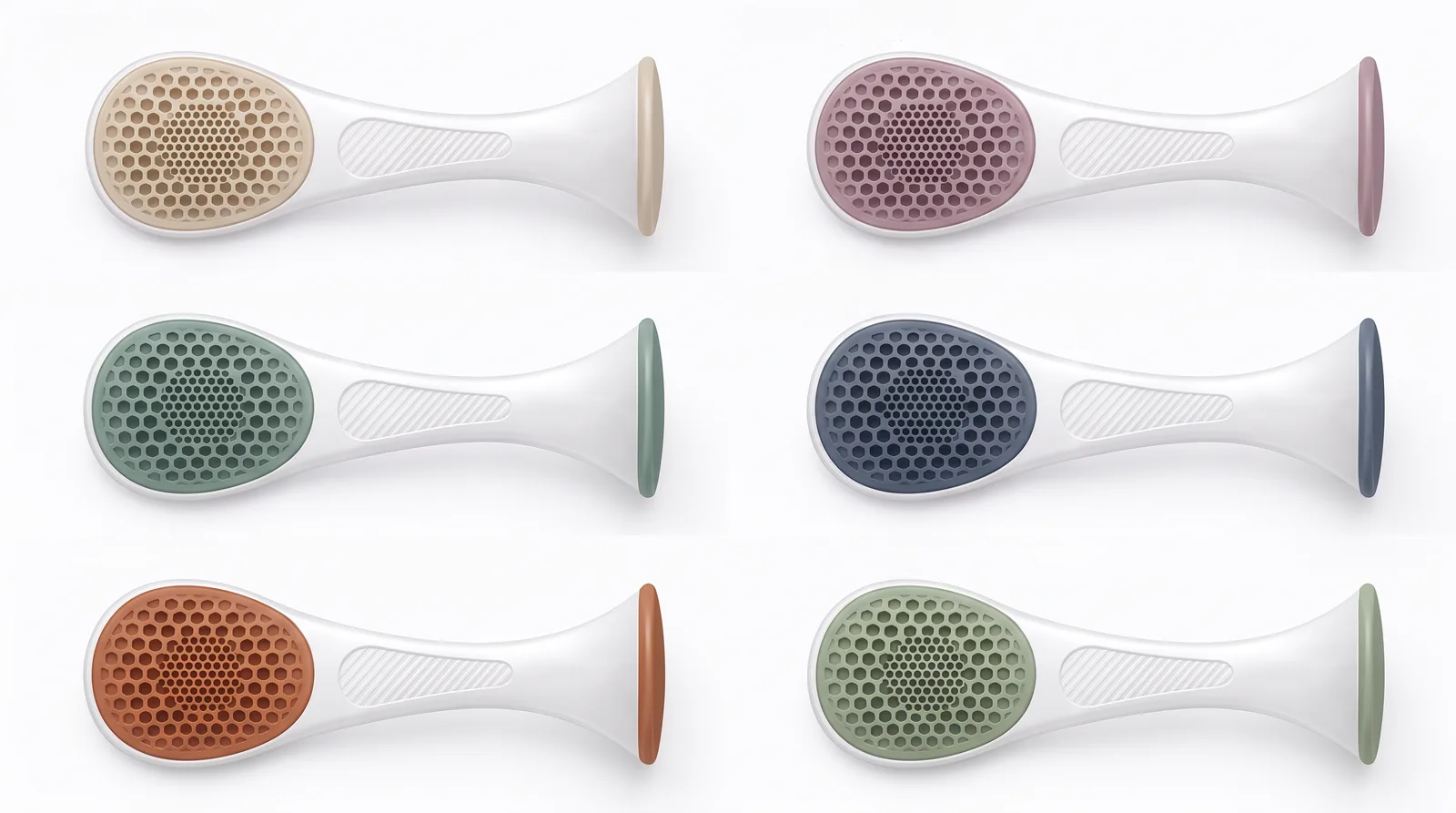
Design and oral ergonomics
Contact interface
Pad geometry, texture and softness are design variables for oral contact.
Grip and removal
Handle proportion and access support placement and retrieval.
Human-factors testing
Comfort, retention, gag response and safe use remain validation requirements.
Pharmaceutical development
MEDORA Rx
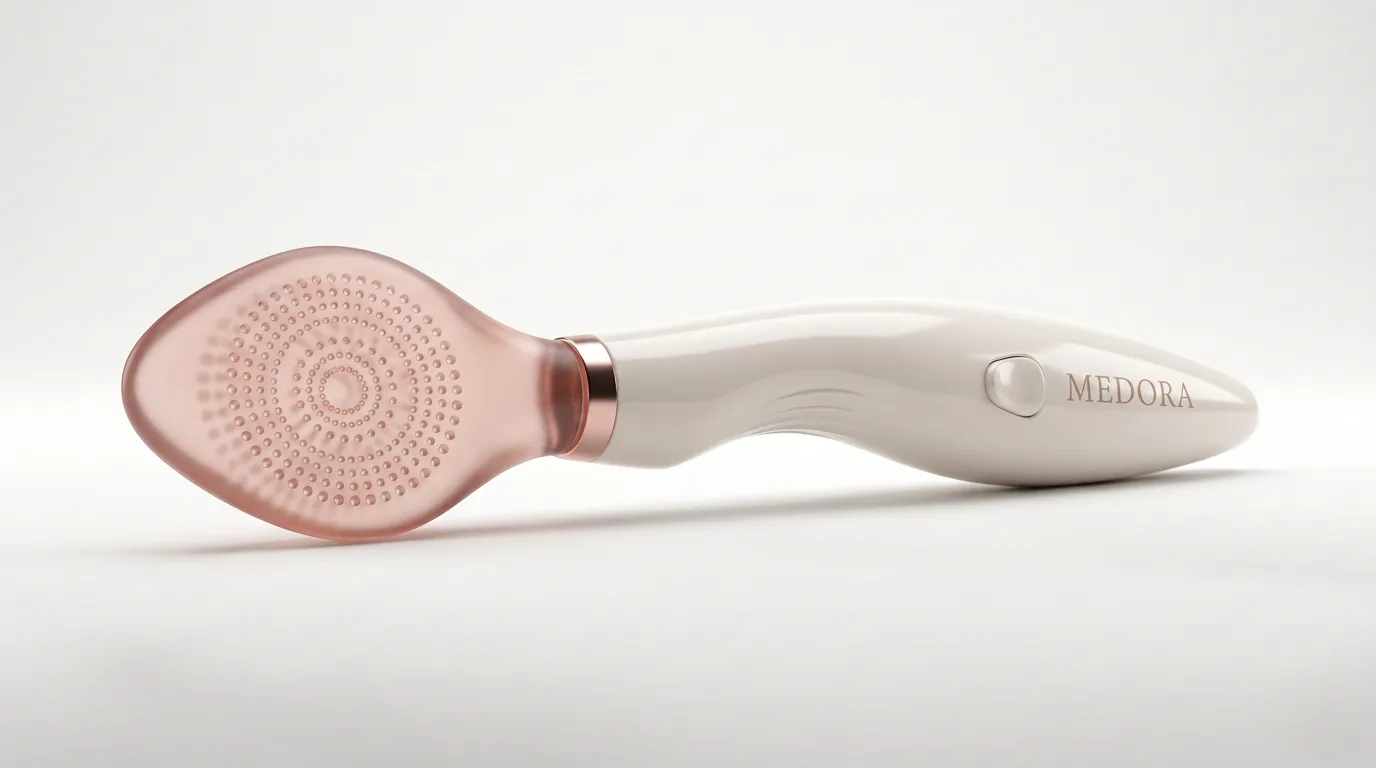
Candidate-specific delivery
Investigate selected local, buccal or sublingual applications.
Formulation target
Define loaded amount, intended delivered amount, contact time and release window.
Partnership opportunity
Screen a focused candidate with formulation, device and clinical-development partners.
Formulation options
Matrix and release layers
Direct dispersion in silicone; pore-former pathways; multilayer designs.
Additional formulation approaches
Nanoparticle or cyclodextrin systems; integrated hydrogel layers for selected ingredients.
Selection criteria
Compare compatibility, stability, release reproducibility and manufacturability. No single strategy fits every molecule.
Exploratory candidates: local and oral use
Local anesthetics
Lidocaine, benzocaine, tetracaine: investigate local delivery.
Dental / periodontal
Chlorhexidine: investigate local antiseptic exposure.
Antiemetics and nicotine replacement
Ondansetron; nicotine: separate candidate-specific development programs.
Examples are screening concepts, not established MEDORA indications.
Exploratory candidates: systemic delivery
Hormone therapy
Testosterone, estradiol, progesterone: assess formulation and mucosal delivery suitability.
Pain management and cardiovascular
Buprenorphine, naloxone; nitroglycerin, nifedipine: assess each molecule independently.
Neurological candidates
Zolpidem, sumatriptan: investigate suitability; no rapid-onset benefit is established.
Each candidate requires independent release, safety and clinical evaluation.
Smoking-cessation development concept
MEDORA™ Sigs™
A familiar format for a different cessation approach: a silicone-based oral device concept combining nicotine-release engineering with behavioral familiarity.
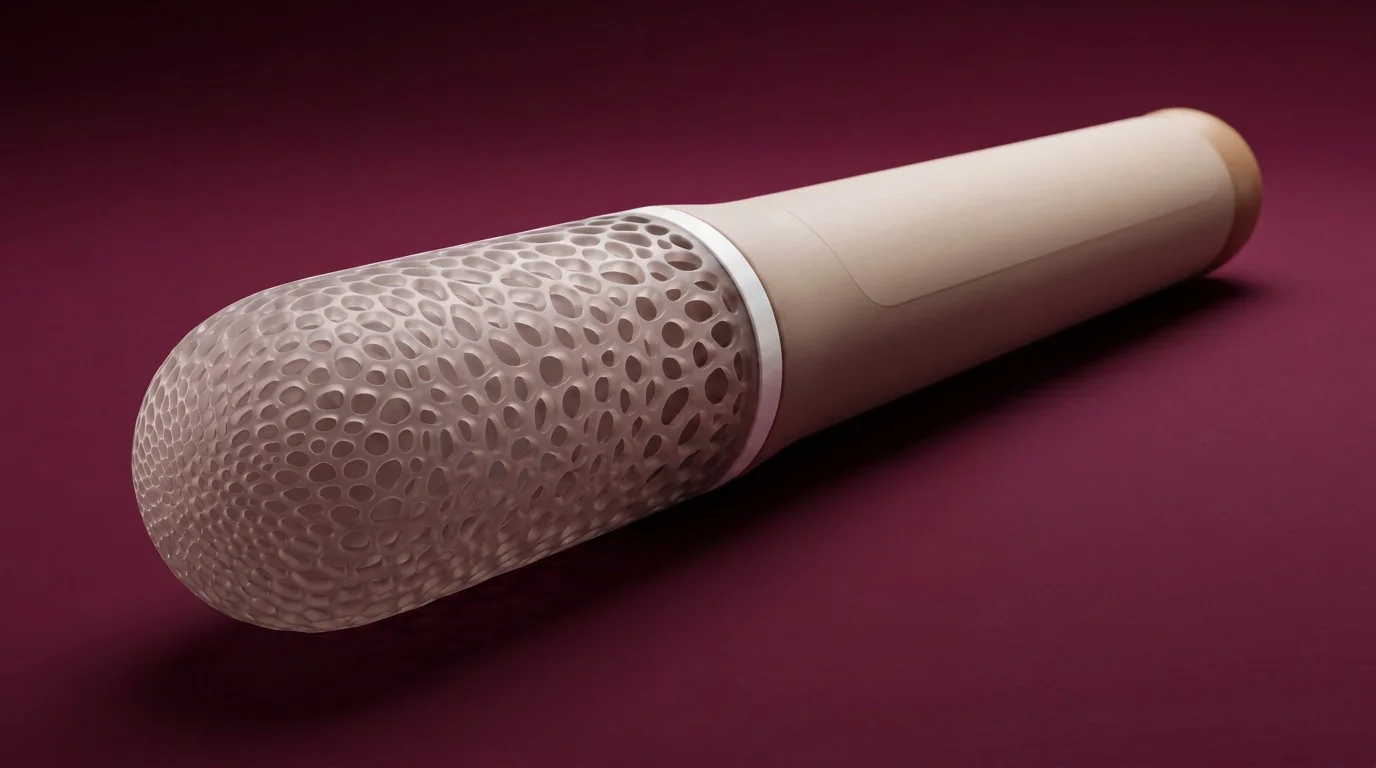
Nicotine and behavioral familiarity
Pharmacological objective
Develop a nicotine-delivery profile for a defined cessation application.
Behavioral objective
Explore hand-to-mouth interaction, tactile cues and oral sensation as part of the transition.
The clinical question
Does combining the two improve tolerability, adherence or quit outcomes? The concept requires clinical evaluation.
The Sigs product concept
Physical format
Cigarette-inspired proportions, rounded contact surfaces and a silicone construction.
Delivery design
Investigate matrix composition, active loading and layered release interfaces.
Proposed progression
Evaluate lower nicotine configurations and a nicotine-free endpoint. Final amounts and schedules remain to be established.
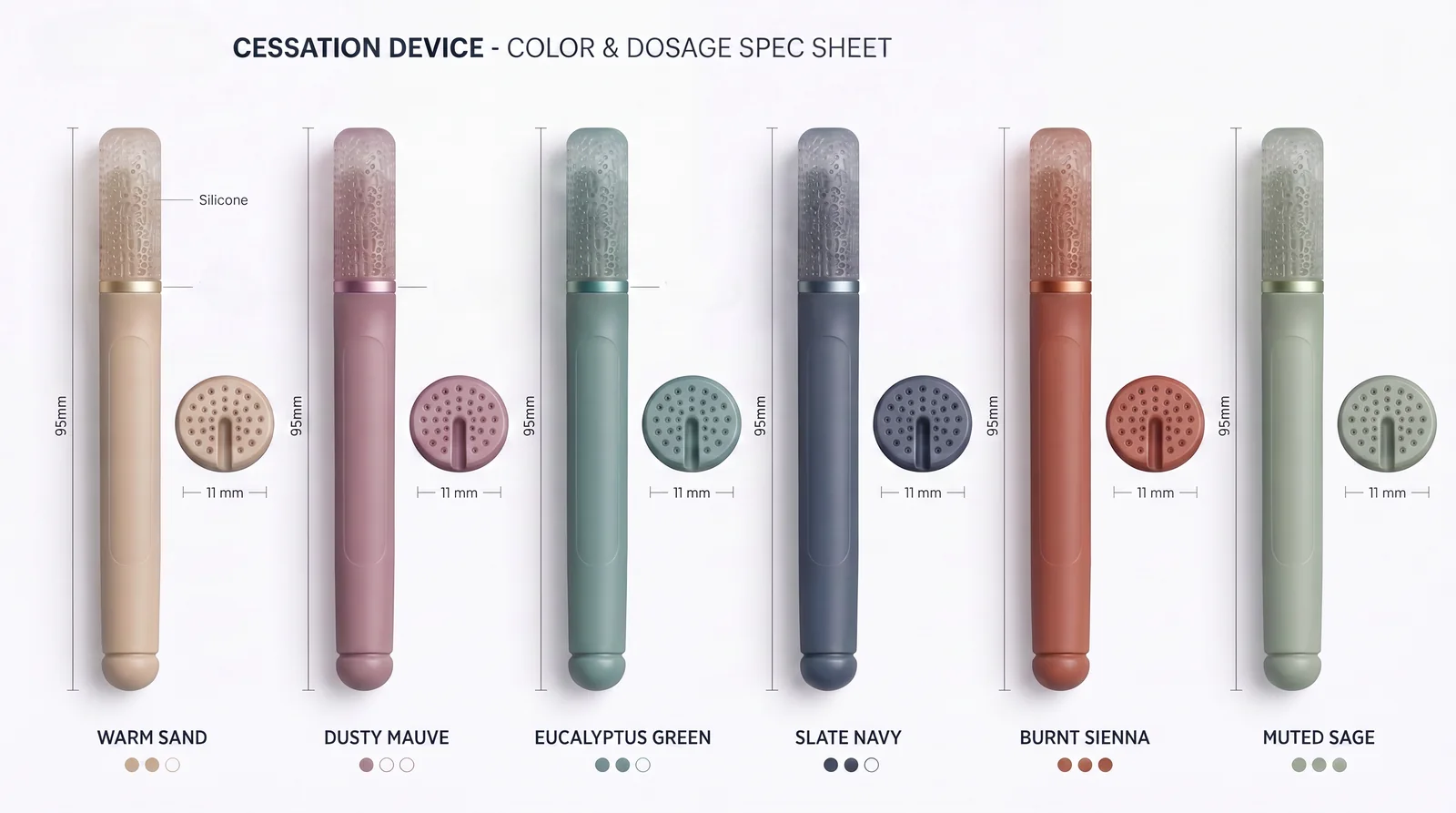
Industrial design
Illustrative dimensions
95 mm length × 11 mm diameter; approximately 9.5 g.
Configuration
A single-use device with multiple colors and finishes.
Qualification
Verify dimensions, weight, material integrity and intended-use behavior in actual prototypes.
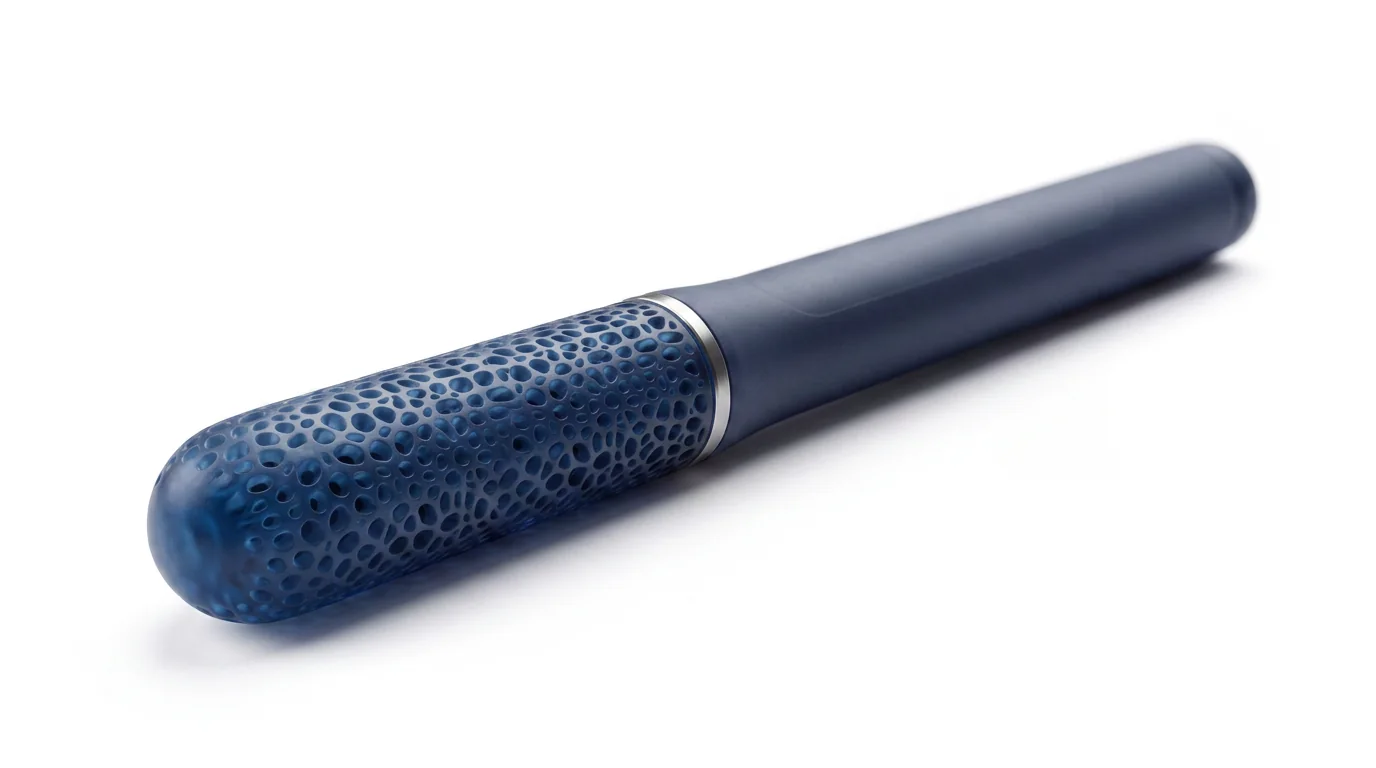
Oral contact and handling
Design intent
Soft rounded geometry and surface texture support a familiar handling experience.
Non-inhaled concept
The design does not include a combustion or aerosol-generation mechanism.
Human-factors requirements
Assess placement, retention, lip contact, bite resistance, retrieval and repeated handling.
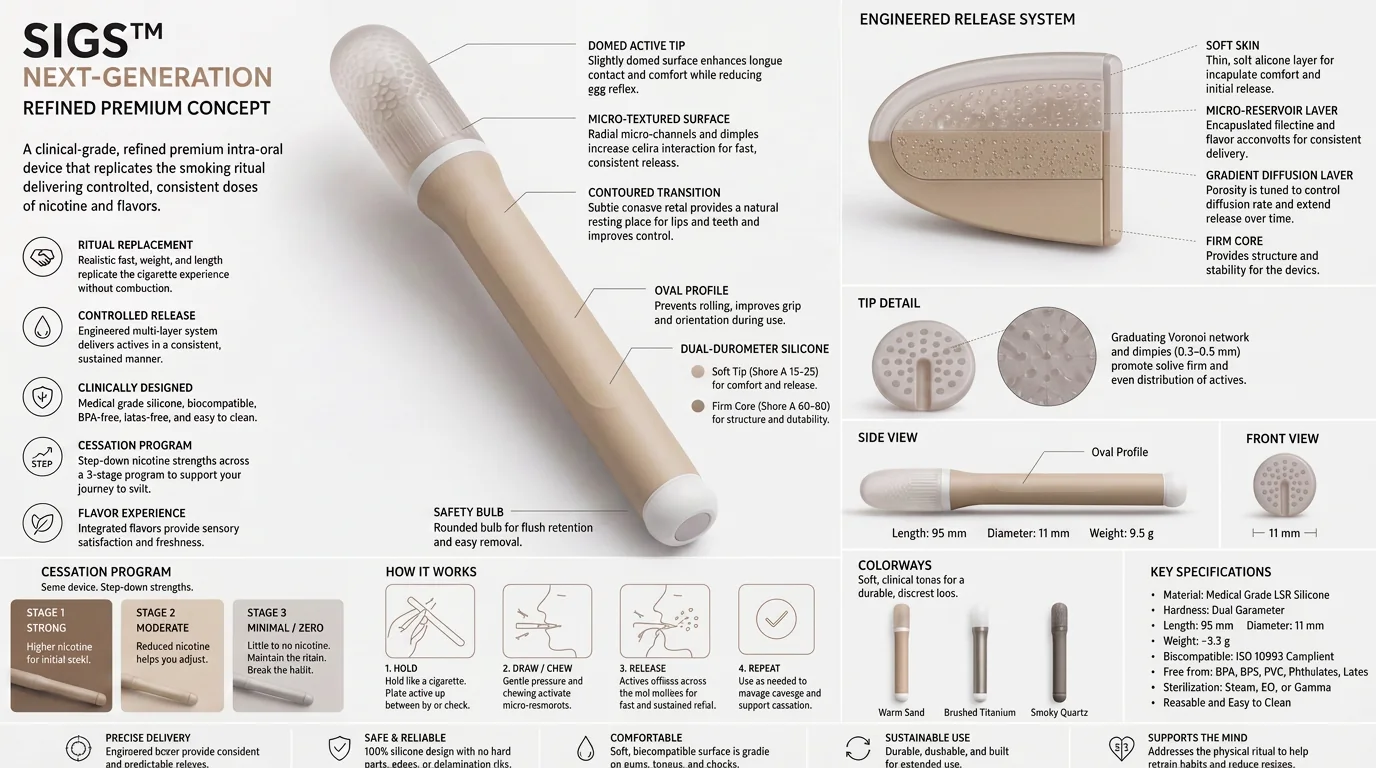
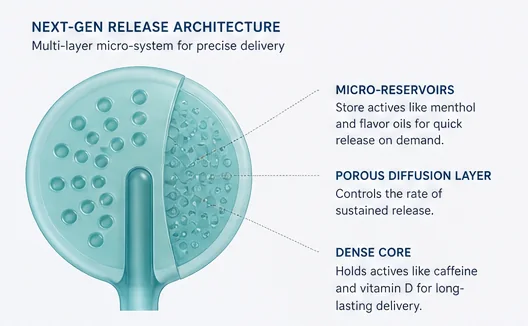
Proposed release architecture
Outer contact and reservoir layers
A soft skin and active/flavor reservoir are proposed elements.
Diffusion and structural layers
A porosity-controlled region and firmer core are proposed for release and support.
Engineering variables
Matrix chemistry, loading, layer thickness, permeability, contact area and dimensions require measured evaluation.
Flavor and stage communication
Flavor concepts
Stage identifiers
Usability objective
Use clear labeling as well as color to identify a configuration. Flavor tolerability and labeling comprehension need testing.
The nicotine development specification
Define the amount
Distinguish nicotine loaded into the device from nicotine released and absorbed during use.
Measure the profile
Assess initial release, release over time, residual amount and batch variation under simulated-use conditions.
Define the exposure
Relate bench release to pharmacokinetics, tolerability and intended duration through an appropriate development program.
Behavioral transition hypothesis
Initial substitution
Investigate whether the format provides an acceptable alternative to selected smoking cues.
Progressive change
Study reduced nicotine exposure alongside changes in ritual and use frequency.
Intended endpoint
The ultimate goal is to stop smoking. A nicotine-free, flavor-releasing SIGS is proposed to preserve the familiar cigarette ritual while supporting the transition away from smoking.
Material and manufacturing qualification
Proposed material
Medical-grade liquid silicone rubber and a dual-durometer construction are design targets.
Process requirements
Establish cure compatibility, nicotine loading uniformity, surface finish and structural integrity.
Qualification targets
Oral-contact biological evaluation, extractables/leachables and verified material declarations. Grade selection alone does not establish finished-product safety.
Evidence required
Bench performance
Reproducible nicotine release, dose consistency, stability and material compatibility.
Exposure and usability
Systemic exposure, tolerability, oral comfort, handling and adherence.
Clinical performance
Controlled evaluation of safety and cessation outcomes.
Development milestones
Materials and bench release
Define the formulation and test method. Compare repeatable prototypes against a target profile.
Exposure and human factors
Plan appropriate pharmacokinetic and usability evaluation with qualified partners.
Clinical and manufacturing decision
Use results to define the clinical program, product pathway and manufacturing qualification requirements.
Development and commercial readiness
Current evidence
Product illustrations, proposed dimensions, formulation concepts and a staged development plan.
Information to be completed
Prototype status · Release/test results · Clinical partner · Relevant IP identifiers/status · Product pathway
Commercial validation
Test user acceptance and manufacturing economics. Market-size and efficacy claims need dated supporting evidence.
Partnership and next step
Formulation and manufacturing
Develop consistent test articles and characterize nicotine release.
Clinical and human-factors partners
Define exposure, tolerability, usability and cessation-study objectives.
Work package
Study scope · Budget/resources · Milestones and timeline
Appendix: development hypotheses
Illustrative taper concept
Illustrative only. Nicotine loading, delivered amount, use frequency and clinical schedule require definition and validation. The quantities and timing are retained as development examples; the source does not establish whether mg denotes loading, release or absorption. This is not a validated regimen or dosing instruction.
Illustrative formulation targets
Nicotine and menthol
Source targets: nicotine 2–4 mg per “dose”; menthol approximately 2%. Define dose meaning and concentration basis.
Caffeine and citric acid
Source targets: caffeine approximately 20 mg; citric acid approximately 3%. These are exploratory co-formulation options.
Required evaluation
Analytical, release, toxicological, pharmacokinetic and clinical assessment; no safety or performance conclusion follows from these amounts.
Positioning to validate: comparison dimensions
Nicotine and physical ritual
Compare SIGS with specific nicotine-replacement and inhaled-product formats.
Combustion, aerosol and release
SIGS is proposed as non-combustion and non-aerosol. Compare measured delivery with a specified comparator.
Taper and nicotine-free configurations
Compare the proposed staged program and nicotine-free endpoint with defined alternatives to validate product performance.
Device engineering exhibit
Controlled-release wellness concept
MEDORA™ Pop★Star™
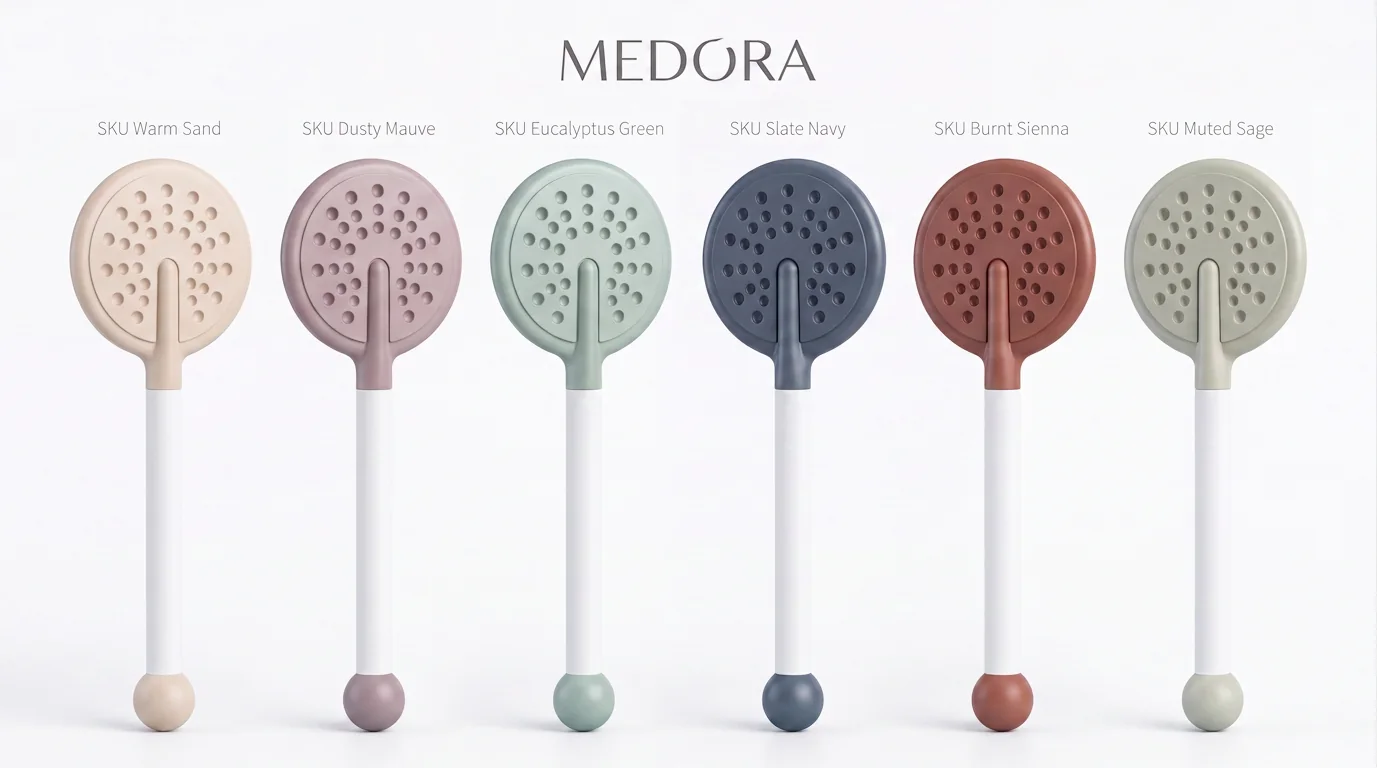
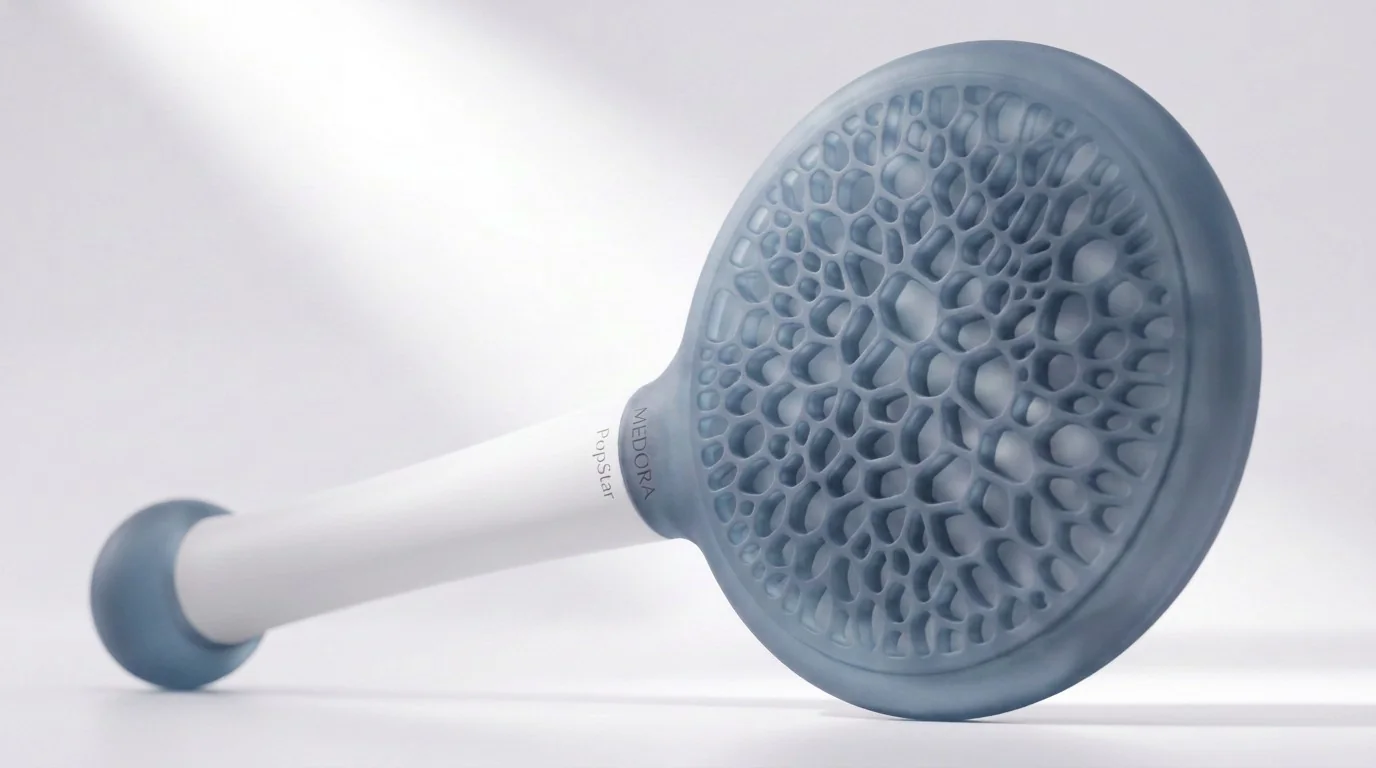
Flavor and formulation in a familiar oral format: a lollipop-inspired device with a cured-silicone release architecture under development.
The product concept
Familiar interaction
A disc-and-handle format designed for oral contact and removal.
Engineered release interface
Explore a silicone matrix, pore-formers and surface geometry for selected ingredients.
Development objective
Demonstrate reproducible release and an acceptable sensory experience before expanding the product line.
Product design and usability
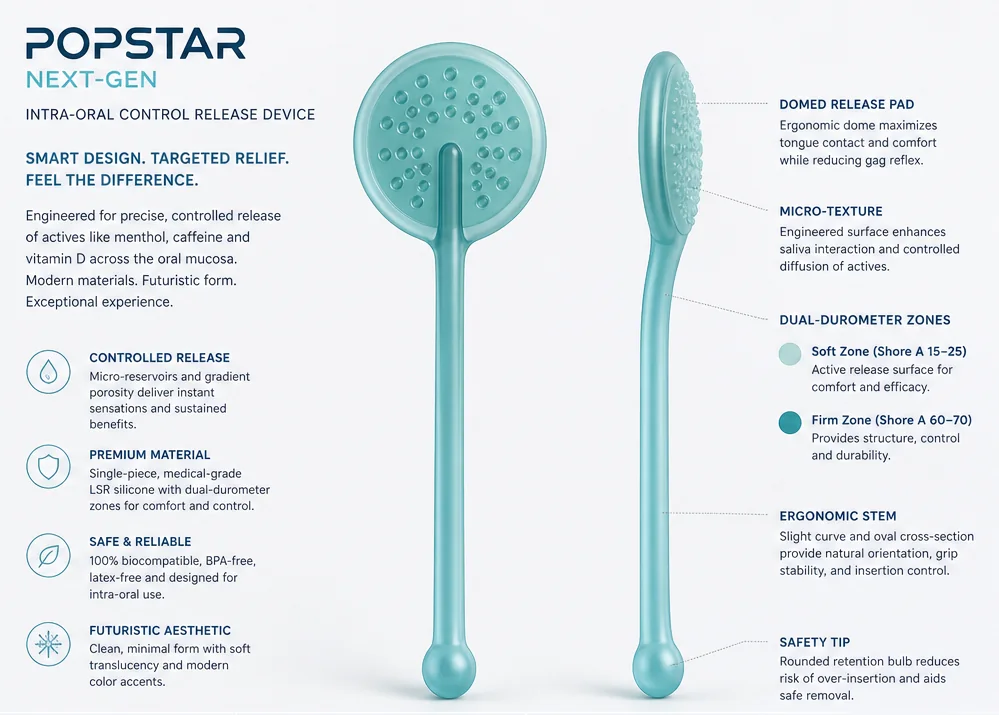
Release face
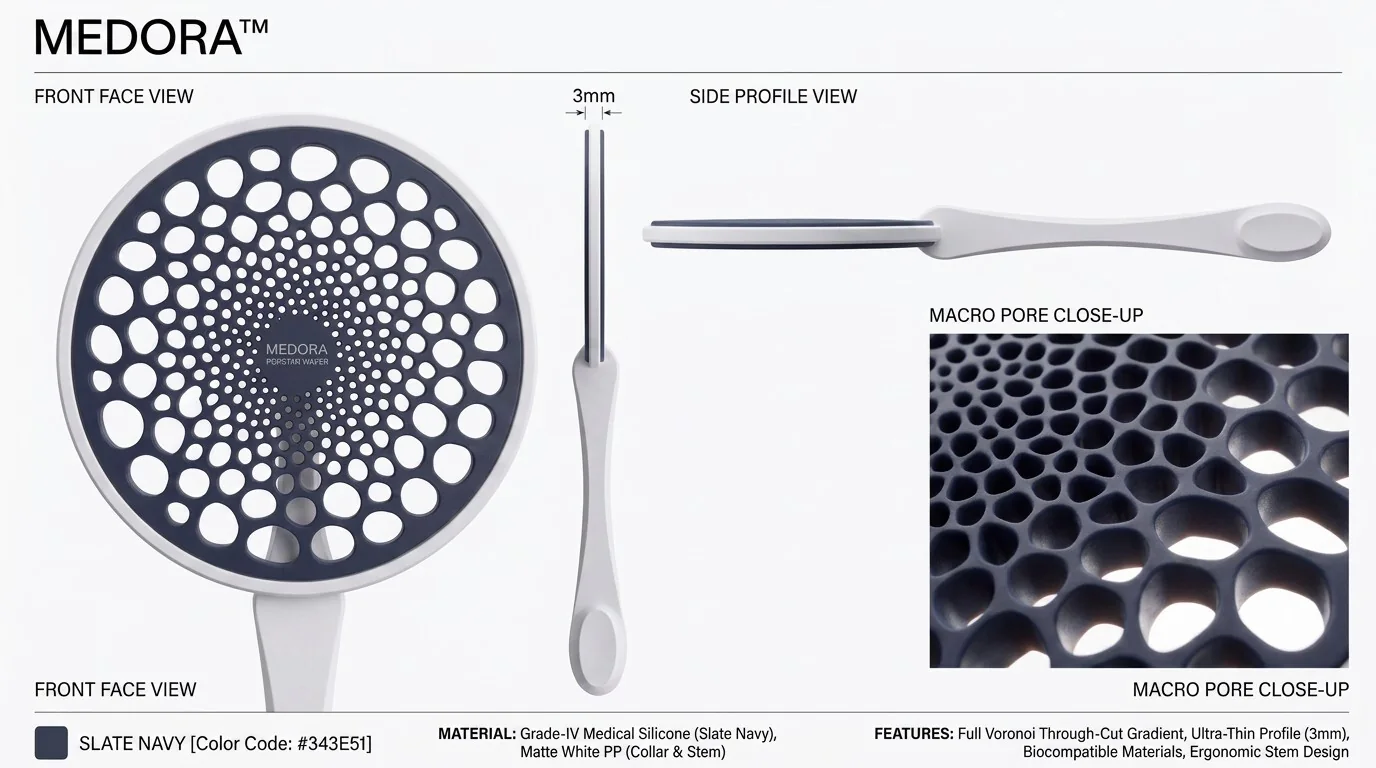
Surface patterns and perforations are design variables that can be engineered to modulate controlled release.
Handle and proportions
Grip, pad dimensions and removal access are part of the user experience.
Validation
Measure retention, bite resistance, structural integrity, comfort and intended-use behavior.
Two proposed release pathways
Matrix diffusion
Investigate selected lipophilic ingredients dispersed within a silicone matrix.
Pore-mediated release
Investigate water-soluble ingredients and pore-formers that can create pathways during saliva contact.
The key test
Measure both ingredient profiles in the same device. Confirm whether the pathways provide the intended behavior.
From formulation to release
Load and wet
Incorporate ingredients into the architecture. Saliva contacts the surface.
Develop pathways
Assess pore-former dissolution and ingredient release under defined test conditions.
Measure over time
Quantify released and residual amounts. Relate results to geometry, matrix and processing variables.
An evolving sensory experience
Initial flavor
Evaluate flavor intensity and its early release.
During use
Measure taste, mouth feel and ingredient release over the intended contact time.
Profile to validate
Immediate, intermediate and steadier phases are formulation targets and their sequence and duration are to be established.
Ingredient selection
Capacity and useful amount
Select ingredients whose intended quantity is compatible with the device’s loading and release capacity.
Compatibility and stability
Assess incorporation, curing, storage stability, sensory properties and release into the oral environment.
Product-specific claims
Define the audience, intended use and substantiation requirements for each formulation.
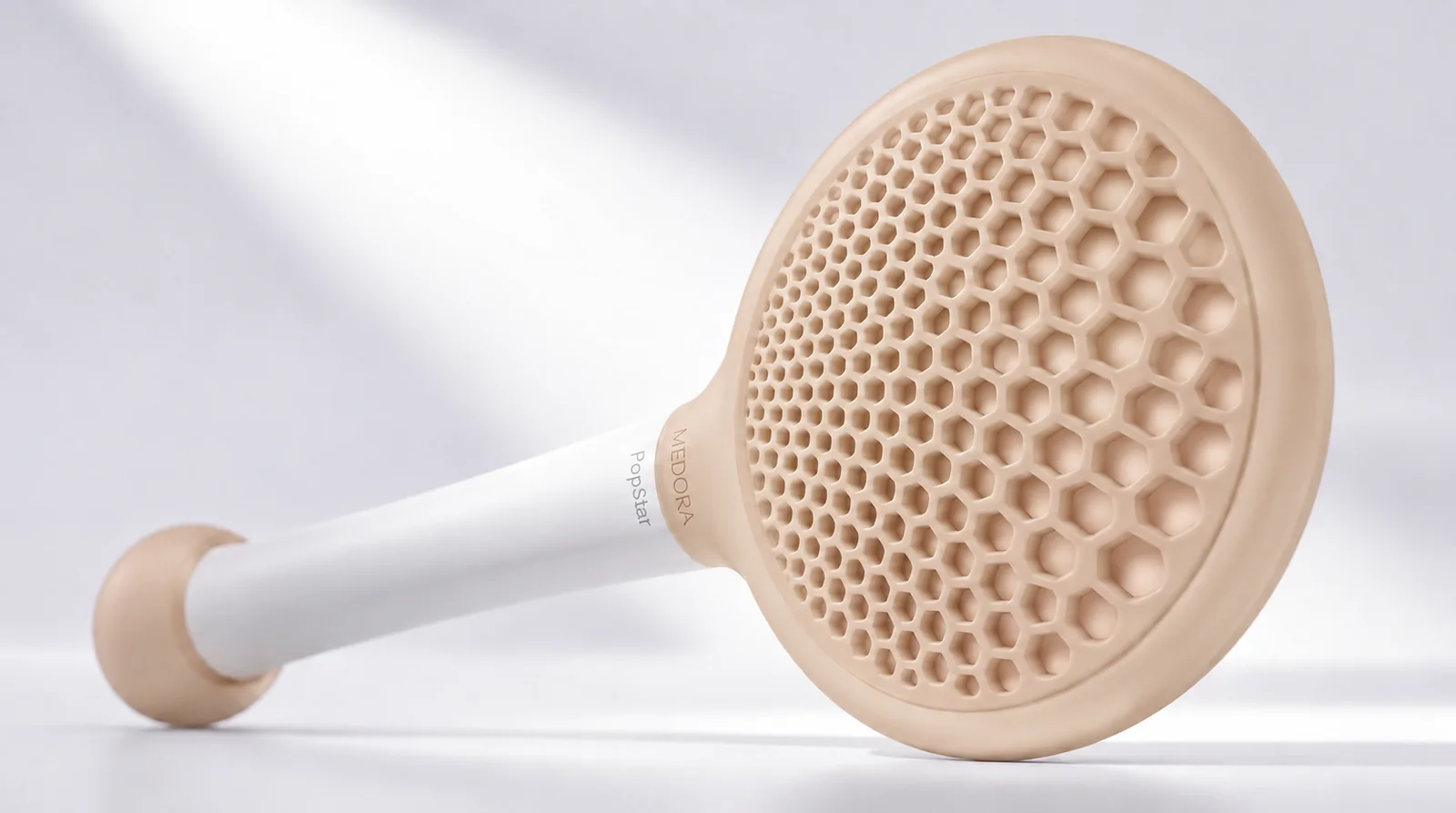
First formulation test: CoQ10 and caffeine
Proposed combination
CoQ10, caffeine, flavor oil and sorbitol as a pore-former.
Development target
The source proposes 30 mg CoQ10. Loaded amount versus delivered amount must be defined; this is not a final serving specification.
Experimental question
Can both ingredients be incorporated and released reproducibly, with a usable sensory profile?
What the first study should measure
Ingredient mass balance
Loaded amount, released amount and residual amount for each selected ingredient.
Release behavior
Initial burst, release over time, lot variation and the effects of geometry and pore-former content.
Compatibility and sensory response
Stability, structural integrity and flavor duration. Set numerical acceptance criteria before testing.
Focus Pop★Star concept
Candidate formulation
Caffeine with L-theanine or another selected ingredient; sorbitol and a flavor system.
Additional phase
Investigate a compatible botanical or lipophilic ingredient where loading and release support it.
Positioning to establish
Focus-oriented branding is a concept. Ingredient release does not itself demonstrate a cognitive benefit.
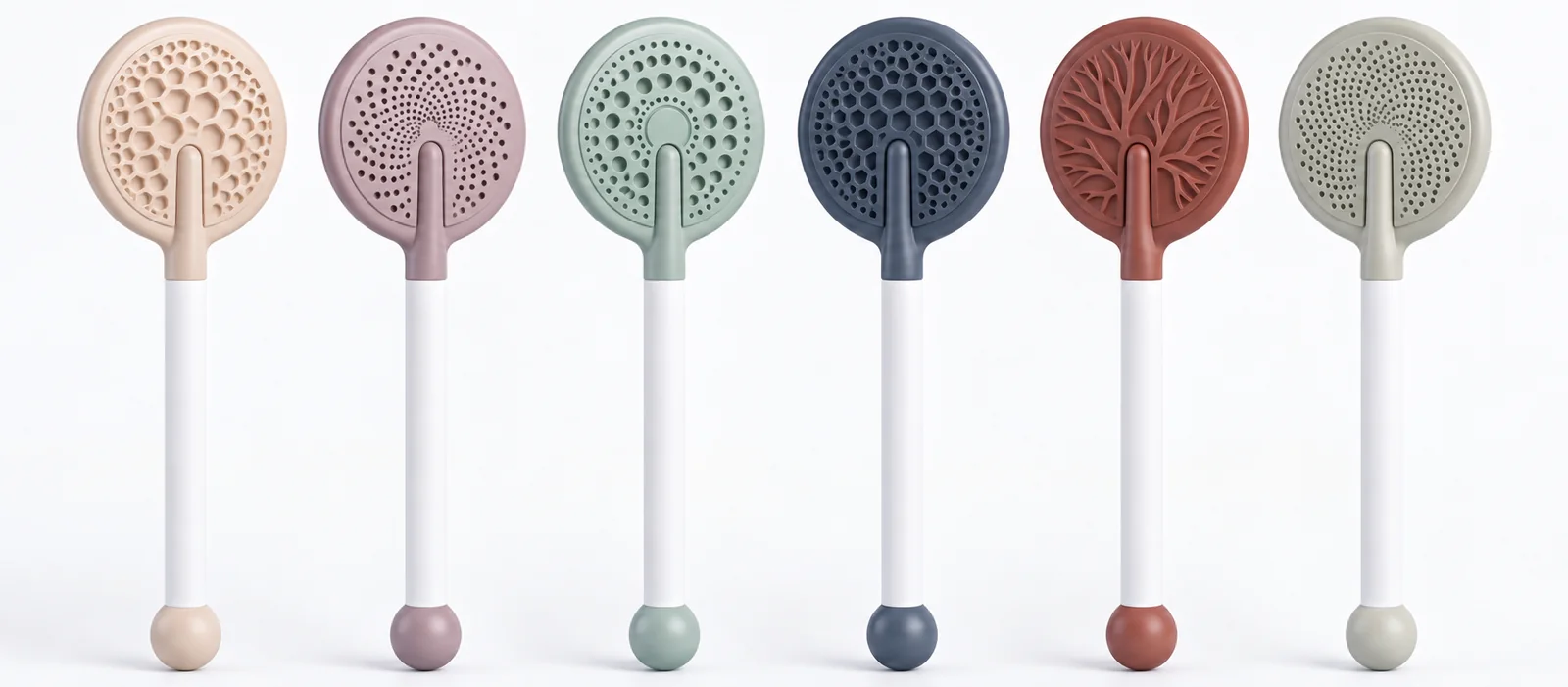
Product-line options
Initial directions
Energy and focus concepts can be compared after the first formulation study.
Later directions
Dream, Defend, Glow and Fitness remain ingredient and positioning options.
Selection gate
Prioritize candidates using measured release, sensory acceptance, safety, manufacturing cost and claim support.
Materials and manufacturing
Silicone system
Select a material and cure process compatible with the intended contact and formulation.
Prototype and mold
Explore custom silicone molding, liquid injection molding and dual-durometer configurations.
Qualification
Verify loading consistency, dimensions, surface quality, cleanliness and repeatable release.
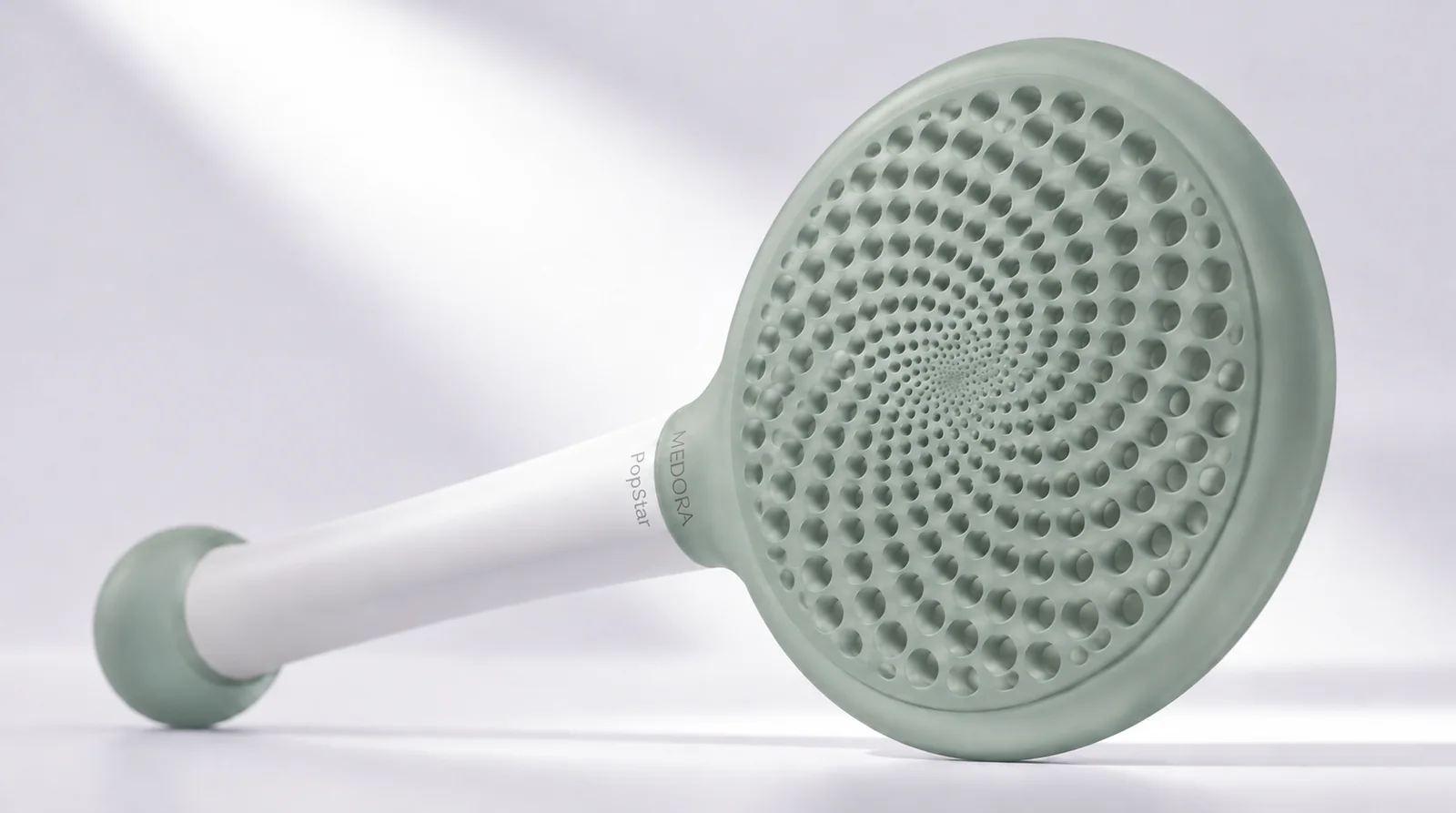
Child-oriented concepts
Separate development program
A familiar form does not establish suitability for children.
Design and use assessment
Evaluate age appropriateness, choking/aspiration risk, bite resistance, retention and retrieval.
Formulation and claims
Define serving, palatability and ingredient suitability for the intended age group before pediatric positioning.
Validation and development milestones
Define and prototype
Choose the lead formulation, contact time and loaded/delivered targets.
Bench and sensory evaluation
Compare release profiles, stability, structural integrity and sensory performance.
Qualify the first product
Establish reproducible manufacture, appropriate claims and product pathway before launch planning.
Commercial assumptions to test
Consumer proposition
Test whether the format and intended use are understandable and attractive to the target audience.
Economics
Measure formulation, molding, packaging and quality costs before setting margins or subscription terms.
Purchase behavior
Compare trial and multipack interest. The source’s prices are hypotheses, not validated willingness-to-pay evidence.
Development status
Available now
Product concepts, release architectures, ingredient examples and illustrative commercial assumptions.
Evidence to establish
Measured dual-release behavior, dose consistency, safety, stability, user acceptance and manufacturing repeatability.
Program details to complete
Lead formulation · Test results/status · Development partner · Relevant IP identifiers and status
Partnership and next step
Formulation partner
Define the first test article and analytical methods.
Manufacturing and evaluation partners
Prepare repeatable prototypes and run release, material and usability studies.
Work package to agree
Milestones · Budget/resources · Timeline
Appendix: design and formulation exploration
Release-face geometry exhibit
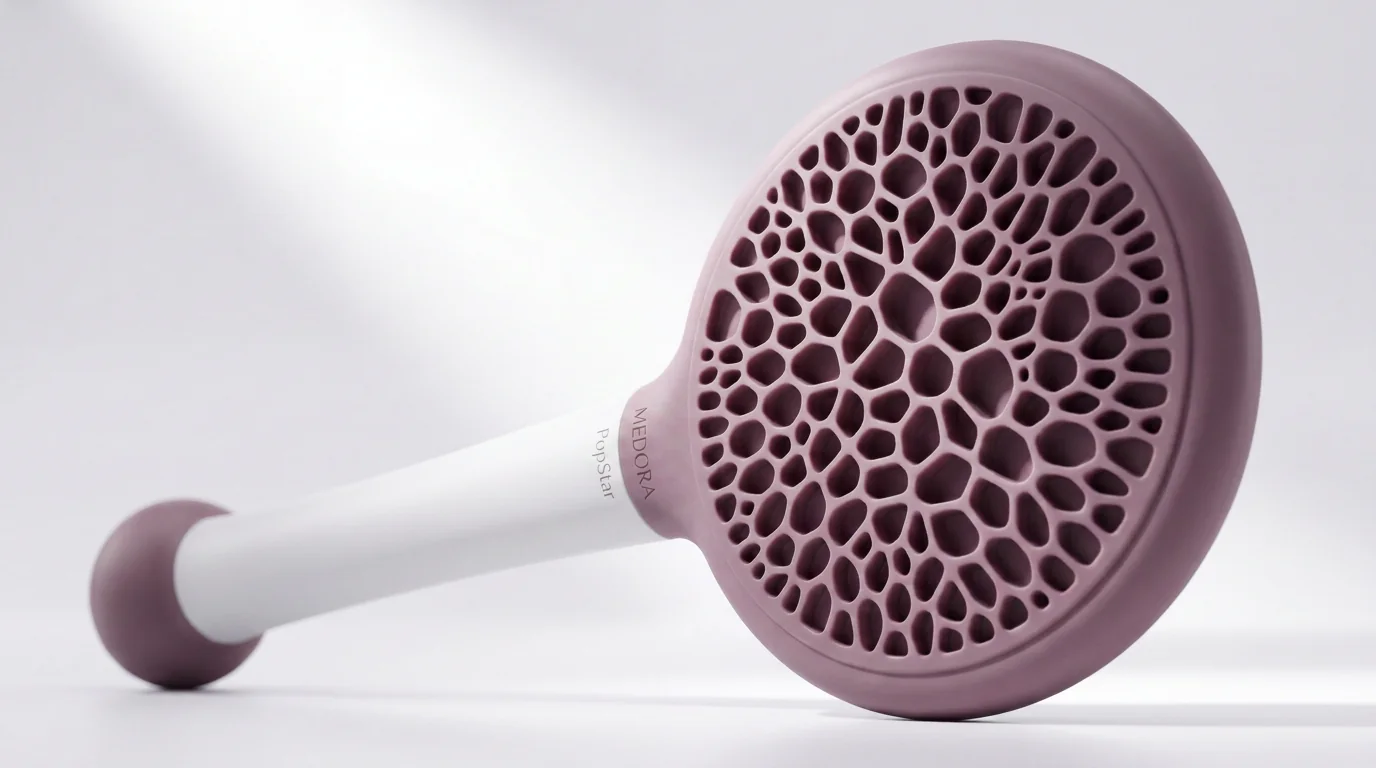
Infinite release-face patterns
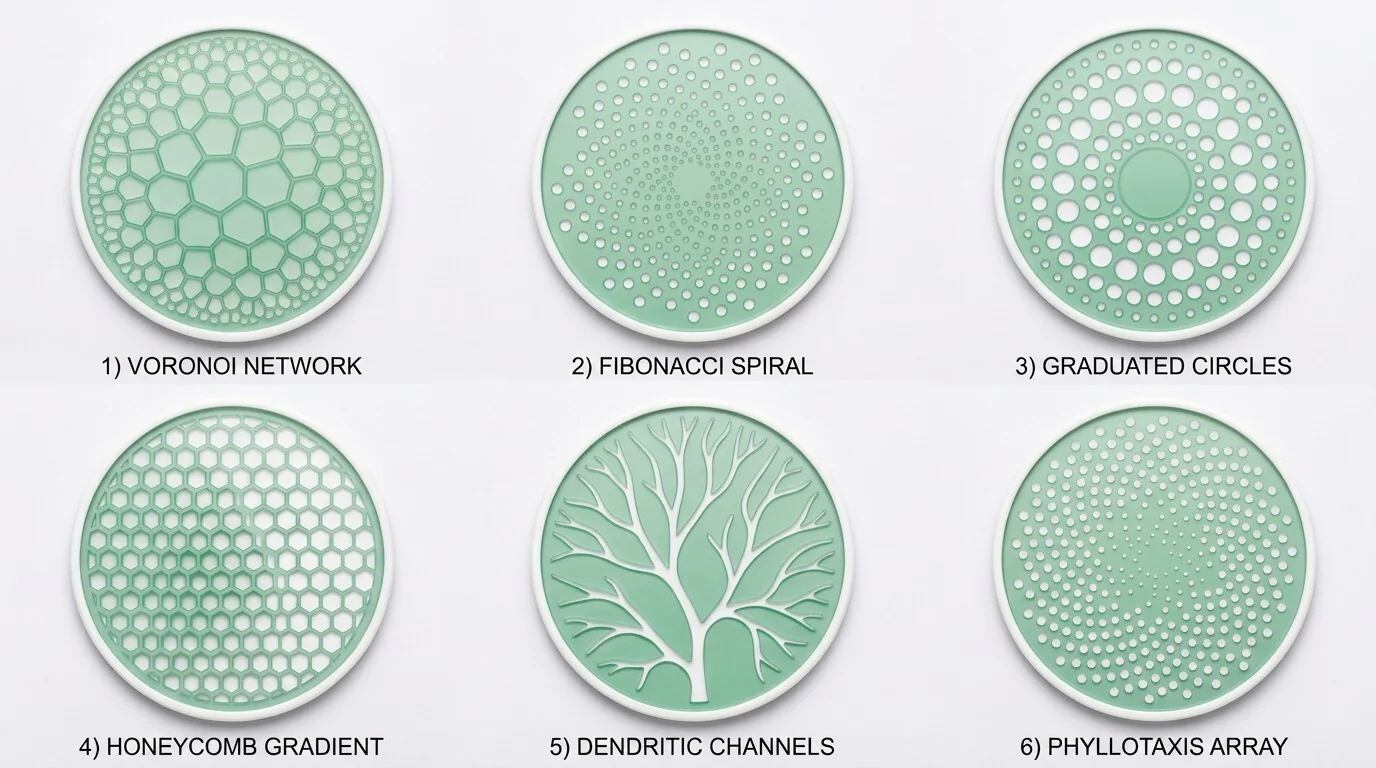
Compare surface geometry using the same formulation and test method.
Ingredient screening examples
Matrix candidates
CoQ10; vitamins D/E/A; curcuminoids; ginger constituents; botanical oils; terpene flavors; lipid-soluble antioxidants.
Channel-release candidates
Caffeine; L-theanine; taurine; citicoline; B vitamins; vitamin C; selected amino acids and electrolytes.
Other formulation variables
Tea constituents, selected nootropics, xylitol, erythritol and salts. Assign each ingredient using measured properties, not a blanket category.
Portfolio combinations under exploration
Energy and cognitive positioning
Caffeine + B vitamins + L-theanine; caffeine + nootropics; alpha-GPC + L-tyrosine + caffeine.
Botanical and performance positioning
Caffeine with green tea/ginger; turmeric/ginger/grape-seed; amino acids; BCAAs; vitamins, minerals, electrolytes and taurine.
Other wellness concepts
Melatonin/L-theanine/magnesium; vitamin C/zinc/elderberry; collagen/biotin/hyaluronic acid; B12/CoQ10/botanicals. Loading feasibility and claims require independent assessment.
Illustrative pricing assumptions
| Format | Illustrative price | Positioning hypothesis |
|---|---|---|
| Single Pop | $1–3 | Trial / convenience |
| 10-pack | $10–25 | Multipack purchase |
| 30-pack subscription | $30–60 | Recurring purchase |
| Kids annual pack | $100–250 | Child-oriented concept |
Source assumptions only. Not confirmed prices, forecasts or an approved pediatric offering.
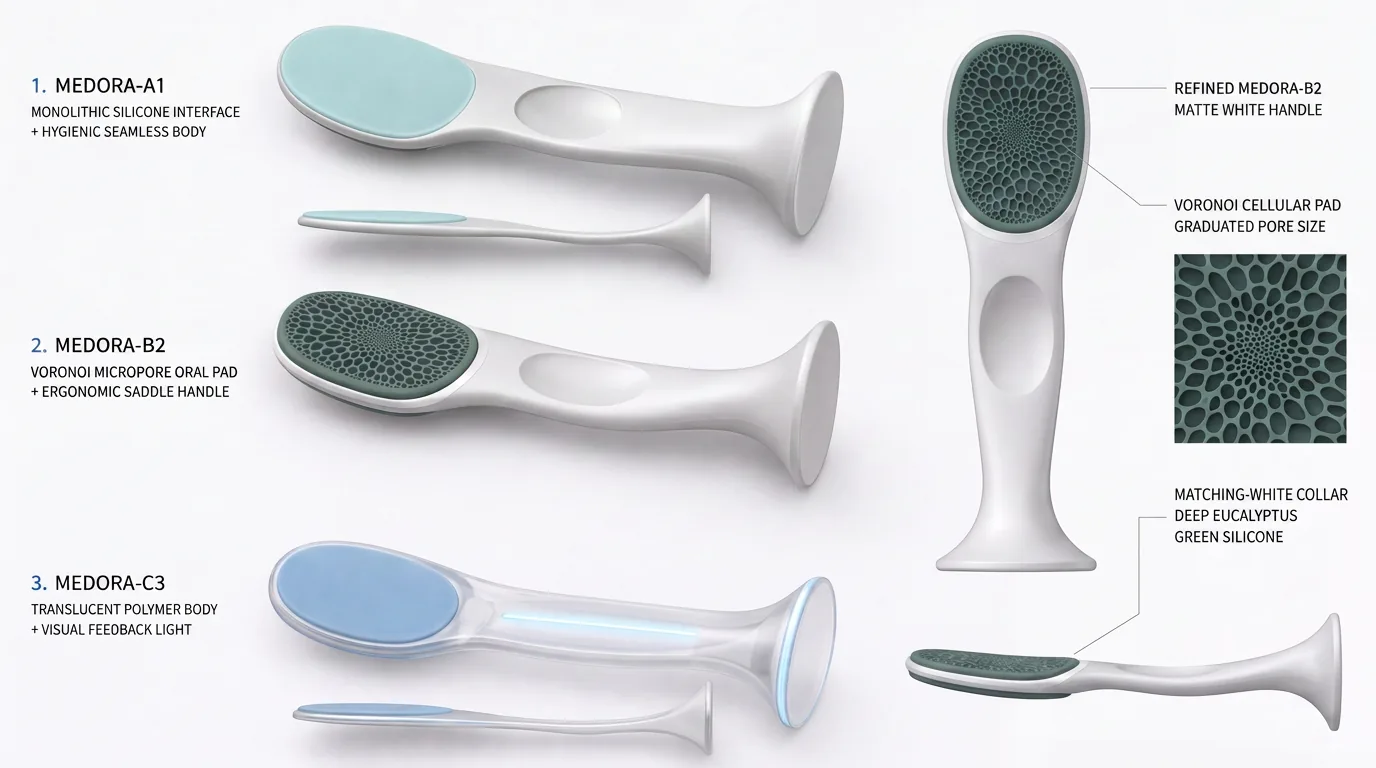
Design-family exploration
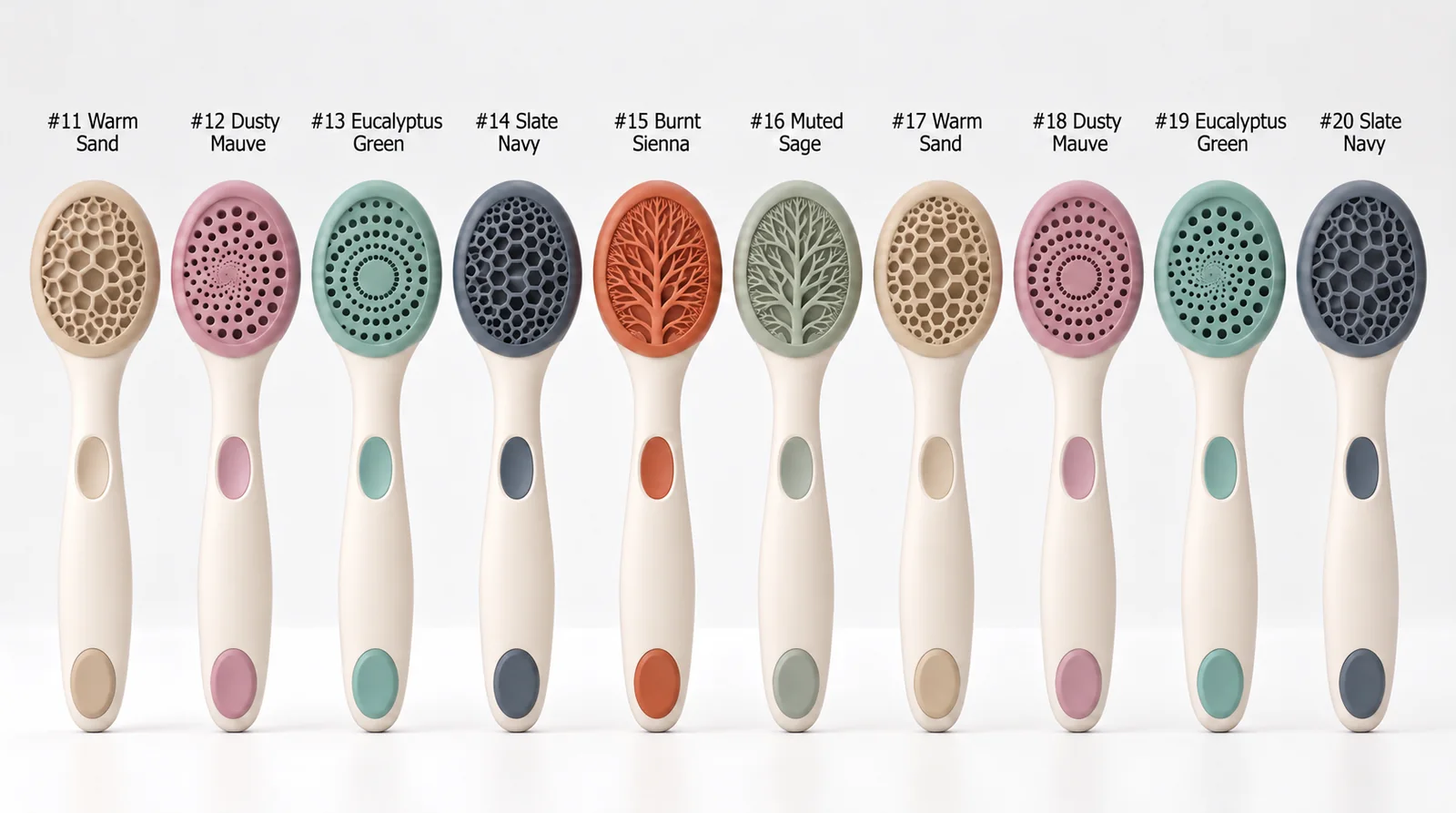
Platform development
From concept to evidence
Materials, validation and a staged program that apply across the MEDORA family.
Materials and manufacturing
Material selection
Cured silicone is the proposed foundation. Select grade, hardness and formulation compatibility.
Manufacturing options
Prototype fabrication, liquid injection molding and dual-durometer designs.
Process qualification
Establish loading consistency, cure compatibility, cleanliness and dimensional control.
Validation priorities
Release and dose
Measure release over time, initial burst, residual amount, uniformity and lot-to-lot variation.
Material safety
Evaluate chemical compatibility, extractables/leachables and biological response for the intended contact.
Usability and manufacturing
Test retention and removal; assess surface finish, structural integrity and reproducibility.
Reference: FDA guidance on ISO 10993-1 biological evaluation of medical devices.
A staged development program
Focused specification
Select one ingredient and intended use. Define measurable performance requirements.
Bench evidence
Build prototypes and compare release, stability, uniformity and material compatibility.
Development decision
Review results and remaining risks before committing to formal preclinical, clinical or manufacturing work.
Regulatory and product strategy
Product-specific pathway
Ingredient, intended use, configuration and claims determine the development requirements.
Drug–device considerations
A drug combined with a delivery device may fall within a combination-product framework. Establish jurisdiction for the specific product.
Evidence before claims
Therapeutic, cessation and wellness claims require appropriate substantiation. No regulatory authorization is established here.
FDA combination-product definition. Classification of a specific MEDORA product is not established by this site.
Development status and evidence
Available now
Device concepts, formulation options and a proposed validation program.
Evidence still required
Measured release curves; delivered-dose reproducibility; stability; safety; usability and manufacturing results.
Program information to complete
Lead candidate · Prototype/test status · Development partners · Relevant patent identifiers and ownership/status
Co-development opportunity
Work with us
Select the first application
Agree the ingredient, intended use and target release profile.
Build the evidence together
Formulation and manufacturing partners develop test articles; testing partners establish reproducibility and safety.
Define the work package
Development scope · Budget/resources · Milestones




- Email:
- [email protected]
- Web:
- www.medora.technology